Multiple Choice
For enzymes in which the slowest (rate-limiting) step is the reaction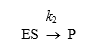
Km becomes equivalent to:
A) kcat.
B) the [S],where V0 = Vmax.
C) the dissociation constant,Kd,for the ES complex.
D) the maximal velocity.
E) the turnover number.
Correct Answer:

Verified
Correct Answer:
Verified
Related Questions
Q8: A good transition-state analog:<br>A) binds covalently to
Q14: Penicillin and related antibiotics contain a
Q15: For a reaction that can take place
Q19: An enzyme catalyzes a reaction at
Q37: The steady state assumption, as applied to
Q46: How is trypsinogen converted to trypsin?<br>A) A
Q65: The difference in (standard) free energy
Q70: For serine to work effectively as a
Q84: A transition-state analog:<br>A) is less stable when
Q90: The role of the metal ion (Mg<sup>2+</sup>)