Multiple Choice
Use the scenario below to answer the following question(s) .
A company makes standard 115-inch-wide rolls of thin sheet metal,and slits them into smaller rolls to meet customer orders for widths of 13,16,and 25 inches.The demands for these widths vary from week to week.From a 115-inch roll,there are many different ways to slit 13-,16-,and 25-inch pieces.
A cutting pattern is a configuration of the number of smaller rolls of each type that are cut from the raw stock.Of course,one would want to use as much of the roll as possible to avoid costly scrap.For example,one could cut seven 16-inch rolls,leaving a 3-inch piece of scrap.Finding good cutting patterns for a large set of end products is in itself a challenging problem.Suppose that the company has proposed the following cutting patterns: 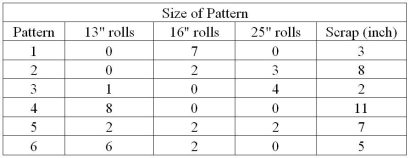 Demands this week are 1,000 13-inch rolls,1,430 16-inch rolls,and 1,260 25-inch rolls.The problem is to develop a model that will determine how many 115-inch rolls to cut into each of the six patterns in order to meet demand and scrap.
Define Xi to be the number of 115-inch rolls to cut using cutting pattern i,for i = 1,…,6.
Note that Xi needs to be a whole number because each roll that is cut generates a different number of end items.
-If we are to use Solver to generate the optimal solution,determine the number of 115-inch rolls produced using the cutting pattern 1.
A) 172 units
B) 1,264 units
C) 316 units
D) 0 units
Correct Answer:

Verified
Correct Answer:
Verified
Q50: Use the data shown below to answer
Q51: Use the scenario below to answer the
Q52: Use the case below to answer the
Q53: A mixed integer linear optimization model differs
Q54: Use the case below to answer the
Q56: Use the case below to answer the
Q57: Use the scenario shown below to answer
Q58: Use the case below to answer the
Q59: Use the case below to answer the
Q60: Use the case below to answer the