Multiple Choice
Table 13-7
A professor dutifully holds six office hours per week as dictated by an archaic policy.Demand for office hours varies wildly as reflected in this historical data.
 The duration of time to answer questions varies independently from the actual demand.Question duration is reflected in this table.
 Entries in the student demand and question duration tables that reflect a range in demand, i.e., 3-9 students per six hours or 4-9 minutes should be treated as collapsed entries in the table.Thus, a question duration of 4 minutes has a 0.05 probability, a question duration of 5 minutes also has a 0.05 probability, and so on up through 9 minutes and a 0.05 probability.
This table contains random numbers for the number of students and duration of question for a 16-week period.
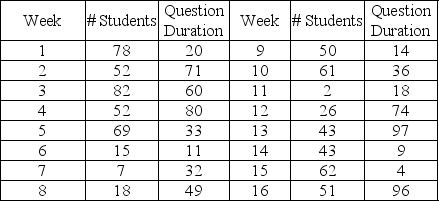 Use the question duration figure as the time required to answer questions for each student that week, so if three students arrive in week seven and the average duration is ten minutes, the total time spent answering questions that week is thirty minutes.
-Use the information in Table 13-7 to determine the range of random numbers that corresponds to a seven-minute question.
A) 40 to 45
B) 41 to 45
C) 40 to 44
D) 41 to 44
Correct Answer:

Verified
Correct Answer:
Verified
Q50: One disadvantage of simulation is that it
Q51: Validation relates to building the right model.
Q52: Table 13-7<br>A professor dutifully holds six office
Q53: A simulation that tests the number of
Q54: Table 13-1<br>The table below represents the probability
Q56: The process of determining that the computer
Q57: If we are using a Monte Carlo
Q58: In assigning random numbers in a Monte
Q59: Table 13-4<br>A pawn shop in Arlington, Texas,
Q60: Explain what is meant by a Monte