Multiple Choice
The simple harmonic motion of an object is described by the graph shown in the figure. What is the equation for the position x(t) of the object as a function of time t? 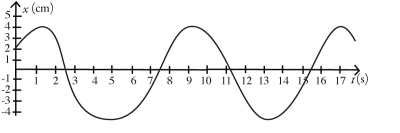
A) x(t) = (4.0 m) sin[(2π/8.0 s) t + π/3.0]
B) x(t) = (4.0 m) cos[(2π/8.0 s) t + 2π/3.0]
C) x(t) = (4.0 m) cos[(2π/8.0 s) t + π/3.0]
D) x(t) = (4.0 m) cos[(2π/8.0 s) t - π/3.0]
E) x(t) = (8.0 m) cos[(2π/8.0 s) t + π/3.0]
Correct Answer:

Verified
Correct Answer:
Verified
Q1: An object of mass 6.8 kg is
Q11: The x component of the velocity of
Q11: An object is attached to a vertical
Q13: A 56 kg bungee jumper jumps off
Q15: A 5.0-kg block is attached to an
Q21: Which of following graphs describes simple periodic
Q23: A 2.15 kg lightly damped harmonic oscillator
Q28: An ideal massless spring with a spring
Q39: A large stick is pivoted about one
Q49: A sewing machine needle moves up and